Intelligence Is Now a Commodity. Trust Is the Only Thing Left to Own.
Stop optimizing for output volume. Every publish should ask, "Does this add a verifiable data point to my track record?" — not "can I produce this?"
Category:
Visual Identity
Author:
reKursive Content Engine
Read:
4 mins
Date:

In January 2025, ClickUp's blog was pulling in 1.19 million organic visitors a month. Fifteen months later, in April 2026, that number was 28,790 — a 97.6% collapse. Over the same period, ClickUp didn't cut back. It added 2,815 new posts, a 67% increase in total content volume, most of it AI-assisted, templated, and optimized for conversion rather than for the reader's question.
That is the whole crisis compressed into one company: more production, less reward.
For twenty years, the operating assumption in content, marketing, and even software was simple — output compounds. Write more, rank more. Ship more, win more. Generative AI didn't break that assumption gently. It broke it by removing the constraint that made it true in the first place: production used to be hard, so producing more was a signal of capability. Now production is nearly free, so producing more is just noise with a CTA on it.
What actually changed
The mechanism is not complicated. Ahrefs analyzed 900,000 newly published English-language web pages in April 2025 and found that 74.2% contained AI-generated content — only 25.8% were purely human-written, and 2.5% were fully AI with no human input at all. The generative AI content-creation market backs this up structurally: Grand View Research valued it at $14.8 billion in 2024 and projects $80.1 billion by 2030 — a 32.5% CAGR. That's not a tool being adopted. That's an entire cost structure collapsing.
Here's the part most operators miss: this alone is not the problem. In a separate 600,000-page study, Ahrefs found essentially zero correlation (0.011) between how much AI content a page contains and how it ranks. Google doesn't punish AI. It doesn't reward volume either. The correlation between effort and outcome didn't go negative — it went to zero. That's the actual shift, and it's more dangerous than a penalty, because a penalty tells you what to stop doing. A zero correlation tells you that the lever you've been pulling for a decade no longer connects to anything.
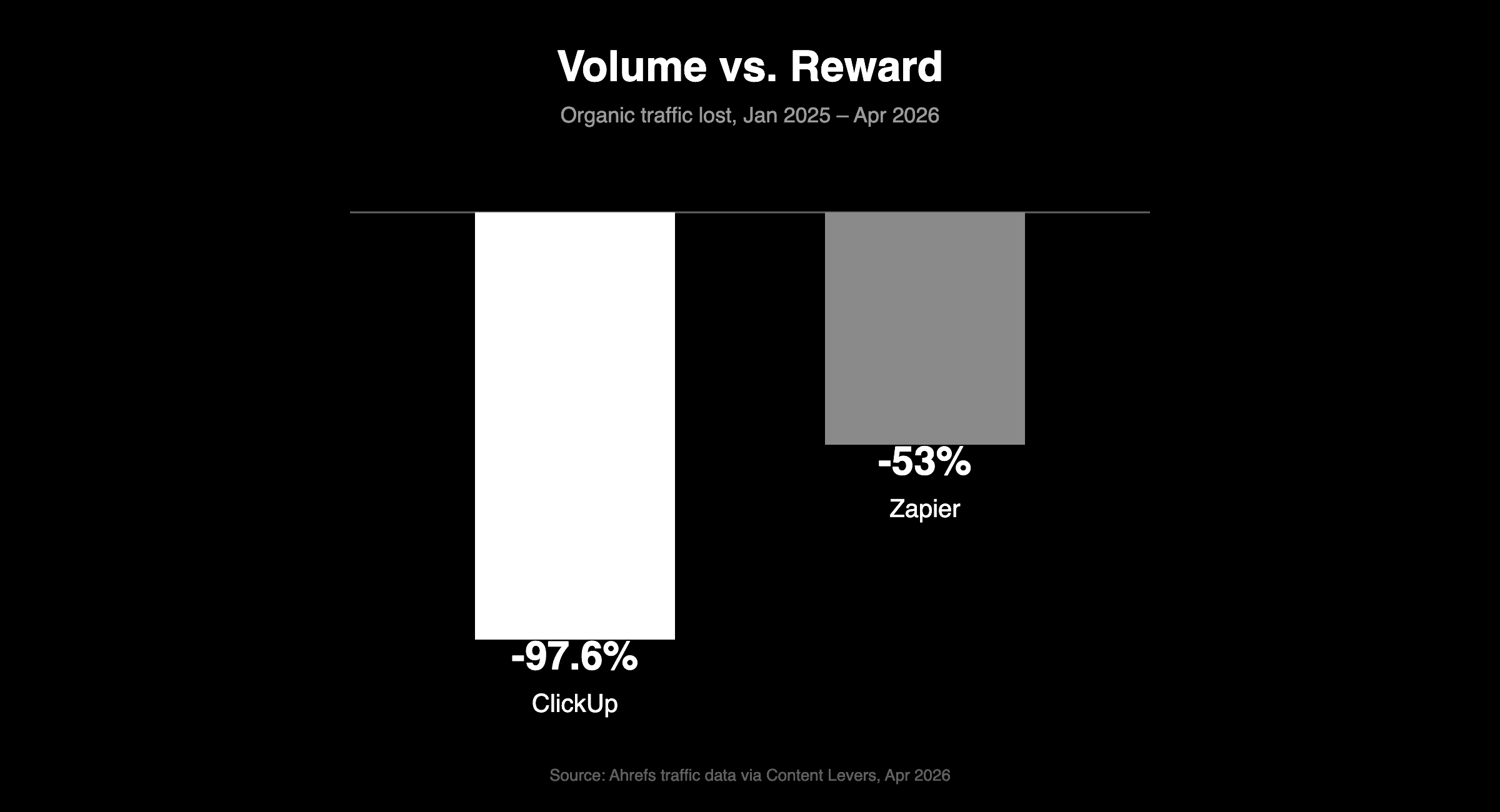
ClickUp is what that looks like at scale. They didn't get flagged for using AI. They got flagged — across multiple Google core and spam updates targeting "scaled content abuse" — for using volume as a substitute for judgment: every listicle ranked ClickUp #1 regardless of fit, every article carried 8–15 CTAs, every "alternatives" page padded itself with irrelevant tools to look comprehensive. Zapier, running the same scale-content model over the same period, lost 53% of its blog traffic instead of 97.6% — a real decline, but a fundamentally different outcome. The difference wasn't AI usage. Both companies use it heavily. The difference was whether a human's judgment was still visibly present in the output, or whether judgment had been fully substituted with volume.
The scarcity list is real — but it's the wrong shape
The standard response to this moment is a list: when intelligence is cheap, taste, judgment, distribution, trust, creativity, data, relationships, execution, and brand all become scarce. You've probably seen a version of this exact list in the last month — it's currently one of the most repeated frameworks in AI marketing commentary, appearing near-verbatim across multiple platforms in 2026.
The list isn't wrong. It's just flat. It treats nine things as parallel, competing moats, as if a founder should go build "taste" on Monday and "distribution" on Tuesday. That's not how any of them actually behave.
Look at what those nine things have in common: every one of them is either an input to trust or an output of it.
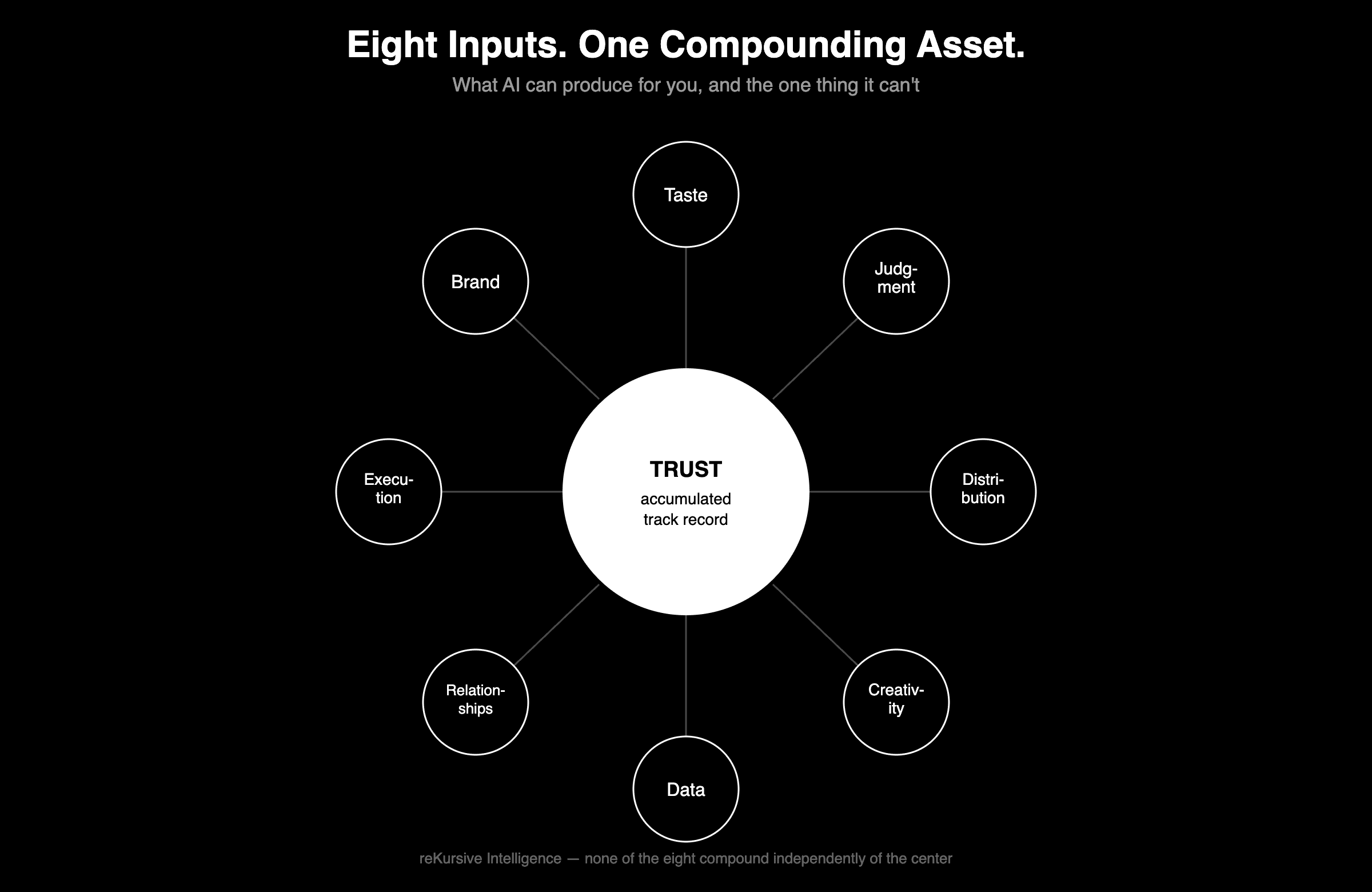
Taste and judgment are how you decide what's worth publishing before the audience tells you.
Creativity and data are raw material — necessary, not sufficient.
Execution is what turns judgment into something real often enough that people notice a pattern.
Relationships and brand are what people call trust once it has a name attached to it.
Distribution is what trust looks like at scale — an audience that no longer needs to re-verify you before they act on what you say.
None of these compound independently. A founder with impeccable taste and zero track record has nothing an algorithm or an audience can act on yet. A founder with distribution but no judgment — ClickUp's blog, essentially — has reach that decays the moment the audience notices the pattern isn't backed by anything. The nine-item list describes symptoms. The underlying asset is singular: an accumulated, unforgeable record of having been right before.
Why AI structurally cannot build this for you
This is the part that matters for anyone building with AI rather than just publishing with it. A model has no memory of being correct. Every generation is evaluated fresh, with no reputational carry-over from the last one. It can produce something that looks like judgment on command, indistinguishable in isolation from something a discerning human made. What it cannot do is accumulate a track record that a specific audience has watched, tested, and decided to trust without re-checking — because that record isn't a property of the output. It's a property of the relationship between a specific author and a specific audience, built one correct call at a time, in public, where people can see the pattern.
That's why "AI made content cheap" is the wrong headline. The more precise claim: AI made individual outputs cheap and left the cost of an accumulated, verifiable pattern of good calls exactly where it was — expensive, slow, and non-transferable. You cannot buy, prompt, or automate your way to a track record. You can only compile one, in real time, and it only counts if it was visible while it was happening.
What this means if you're actually building something
If trust is the compounding asset and everything else is a tributary into it, the operating question changes. It's no longer "how do I produce more" or even "how do I have better taste." It's: which of my public calls are being recorded, and is the pattern legible to the people I need to trust me?
Three implications follow directly:
1. Volume without a visible track record is negative, not neutral. ClickUp's 2,815 new posts didn't just fail to help — they diluted the ratio of "verified good calls" to "output," which is precisely what a discerning audience (and, it turns out, Google's classifiers) can detect. If AI lets you 10x your output, it also 10xs the punishment for publishing without a point of view.
2. Distribution you don't own is a rental, not an asset. Reach that lives inside someone else's algorithm — Google's SERP, a platform's feed — can be repriced to zero by an update you don't control, as ClickUp's case shows in the space of one quarter. Owned distribution — an email list, a direct audience on a platform where your history is visible and attributable to you specifically — is the only version of reach that survives a platform's rules changing.
3. The record has to be public and falsifiable to count. A private track record of good judgment is worth nothing to a market that can't see it. This is the actual argument for building in public, publishing predictions before they resolve, and taking positions that can be checked later — not because transparency is a virtue in the abstract, but because an unverifiable claim to good judgment isn't a moat, it's an assertion.
The recommendation
Stop treating content production and trust-building as the same activity, because AI has made it possible to do a huge amount of the first while doing none of the second. Before publishing anything now, the operative question isn't "can I produce this" — that's solved — it's "does this add one more verifiable, visible data point to the pattern someone can use to trust me next time." If it doesn't, it's volume, and volume is now the cheapest, least differentiated thing in the market.
The founders and brands who come out of this period ahead won't be the ones who produced the most. They'll be the ones whose name became a reliable shortcut for "already checked, already good" — because that's the one thing left that a model, however capable, cannot generate on demand.
reKursive builds the AI systems — content pipelines, agents, and marketing infrastructure — that let teams compound a real track record instead of just increasing output. If you're trying to turn AI-driven production into an owned, trusted distribution asset rather than more noise in the feed, talk to us about an AI marketing system built around your point of view.