The Age of Synthetic Everything: When Reality Becomes Optional
A working framework for deciding what to build (differentiation systems) vs. what not to compete on (raw generation) as synthesis commoditizes.
Category:
Design
Author:
reKursive Content Engine
Read:
5 mins
Date:

The Synthesis Stack
Ten years ago, "AI-generated content" mostly meant a slightly-off stock photo. Today, every layer of the creative and operating stack has a synthetic version, and most of them are already good enough for production use.
Layer | What AI now does | Where it stood in mid-2026 |
|---|---|---|
Images | Photorealistic images from a prompt | Widely described as commoditized — a usable image from any of a dozen free tools in seconds |
Video | Cinematic clips with native audio | Six credible frontier models (Veo 3.1, Sora 2, Kling 3.0, Seedance 2.0, Runway Gen-4.5, Wan 2.6) competing on price and control |
Voices | Cloned, multilingual, real-time speech | ElevenLabs alone crossed roughly $500M in annualized revenue on a reported $22B valuation |
Actors | Fully synthetic performers | Tilly Norwood (Xicoia/Particle6) shopped to talent agencies; Indian studios re-cutting entire back catalogs with AI |
Environments | Explorable, physics-consistent 3D worlds from text | Google DeepMind's Genie 3, now licensed by Waymo for self-driving simulation |
Music | Full songs, vocals included, from a prompt | Suno and Udio each settled with a major label; the category is being legitimized in real time |
Software | Working applications from natural-language prompts | Most surveys put daily AI-tool usage among developers well above 80% |
Marketing | Brand personas, ad copy, full campaigns | A virtual-influencer market estimated in the $10–13B range, growing over 40% a year |
Research | Literature reviews, hypotheses, even peer review itself | At ICLR 2026, roughly 1 in 5 peer reviews were fully AI-written |
Organizations | Agent "teams" that run whole functions without staff | SAP, JPMorgan, and a wave of "0-person" startups are already running functions this way |
Every row on that table used to require a studio, a session musician, a dev team, or a research assistant. Now it requires a prompt. That's the literal mechanism by which the cost of creation is falling toward zero across almost every medium at once.
Faces and Voices That Never Lived
The most visceral version of this is happening to performers. When Eline Van der Velden's studio Xicoia introduced Tilly Norwood in mid-2025, the backlash was immediate — Emily Blunt, Whoopi Goldberg, and dozens of other working actors publicly condemned it, and SAG-AFTRA released a statement insisting creativity "should remain human-centered." That was the first reaction: outrage, on the assumption that outrage could still function as a veto.
It didn't hold. By early 2026, the union had shifted from opposition to negotiation, exploring a tax on studios that use digital performers — an implicit admission that synthetic actors can't be banned, only priced. Meanwhile, India's film industry, unconstrained by anything like SAG-AFTRA's contracts, has leaned in without hesitation: production house Galleri5 told Reuters that AI-assisted filmmaking has cut its costs to roughly a fifth and its timelines to about a quarter of traditional production, and at least one major Indian studio has already used generative tools to rewrite a released film's ending, part of a broader trend of studios combing back catalogs for AI re-releases.
Voice has moved even faster than faces, mostly because it's easier to license and monetize. ElevenLabs went from a dubbing tool to genuine infrastructure: enterprise clients including Salesforce and Cisco, a reported $22B tender-offer valuation, and, as of May 2026, annualized revenue north of $500M. But the same abundance that built that business is now threatening it. In May 2026, journalists and voice actors filed a class action in Illinois alleging the company scraped voices from public recordings without the consent state biometric-privacy law requires — a case that, if certified at scale, could carry damages in the billions and directly challenges the training-data foundation the whole industry sits on.
The World Itself Becomes a Generative Medium
The strangest entry on the stack isn't a person or a song — it's space itself. In August 2025, Google DeepMind introduced Genie 3, a "world model" that doesn't just generate a video of a place, it generates a place: an explorable, physics-obeying 3D environment, built in real time at 24 frames per second from nothing but a text prompt, persistent enough that you can walk away and come back. DeepMind's own framing is unambiguous — it calls world models a stepping stone toward AGI, because they let an AI agent learn by acting inside an unlimited supply of simulated realities instead of a fixed dataset. By February 2026, Waymo had already adopted the technology to build its own self-driving simulation environment.
It's a big enough bet that Yann LeCun reportedly left Meta after twelve years specifically to chase it, raising roughly half a billion euros for a new lab built on the argument that language models will hit a ceiling and the next real gains come from AI that understands physical space, not just text. Whether or not that bet pays off, the direction is telling: the synthetic stack isn't stopping at content people consume. It's moving into the environments AI agents themselves get trained and tested inside.
Culture, Code, and the Companies Running Both
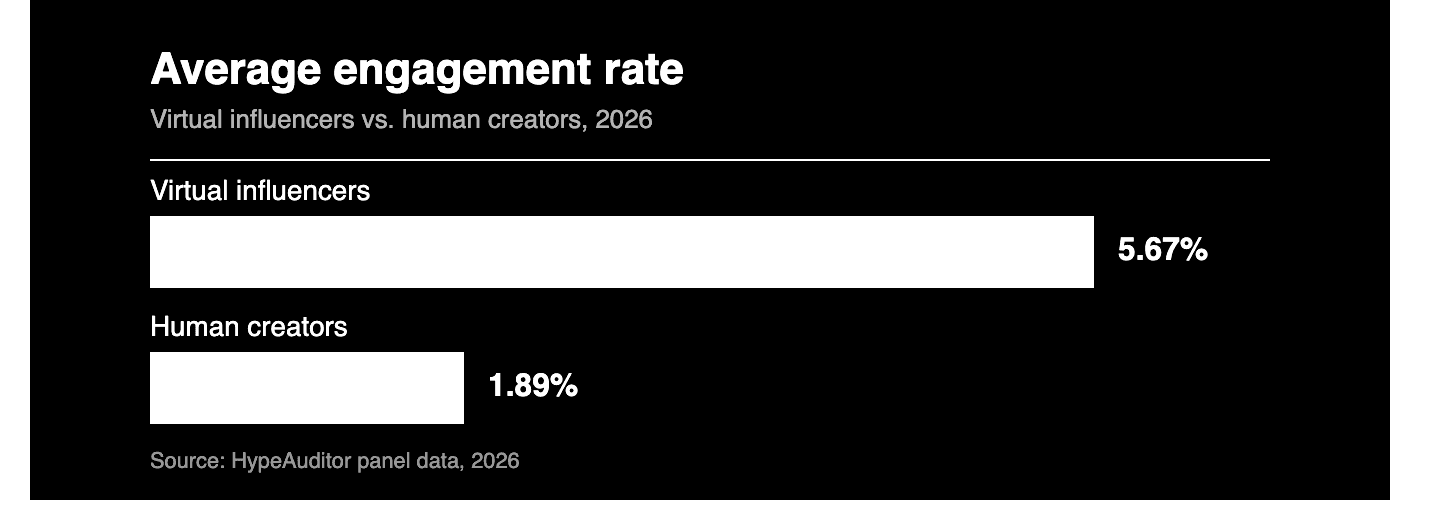
Music tells a version of this story with the clearest paper trail, because it's been fought out in court. Universal settled its suit against Udio in October 2025; Warner settled with Suno the following month, in both cases trading litigation for licensing revenue and a promise to retrain on consented catalogs. Sony refused both deals and is still litigating, betting that a courtroom precedent is worth more than a settlement check. None of that has slowed output: by May 2026, Deezer reported that 44% of new uploads to its platform were AI-generated. Spotify's response was telling — a "Verified" badge specifically for non-AI artists. When a platform starts badging humans, you know which category has become scarce. The same pattern shows up in advertising: virtual influencers already post roughly three times the engagement rate of human creators, and brands are adopting them fast — yet fewer than a quarter of consumers say they're actually comfortable with it. The AI version can outperform and still carry a trust penalty. That gap is the whole story in miniature.
Software tells almost the same story, minus the lawsuits. Somewhere between 84% and 92% of developers now use AI coding tools regularly, and by most counts, AI now writes something like 4 in 10 lines of new production code. What's odd is what's happening to trust while usage climbs: one industry survey put developer confidence in AI-generated code at roughly 29% in 2026, down from about 40% a year earlier — rising adoption and falling trust, at the same time. A randomized controlled trial from METR, run with experienced open-source engineers on real codebases, found something even more counterintuitive: they were measurably slower with AI tools than without them, even though they felt faster. Fast and abundant, in other words, isn't the same as good — and the gap between those two things is exactly where this piece is heading.
The last layer, organizations, is where synthesis stops being about content and starts being about structure. SAP's newly unveiled "Autonomous Enterprise" runs finance, procurement, and HR through more than 200 specialized agents; JPMorgan has said its agents will be capable of running "hours, then days, then weeks" without a human in the loop; Deloitte reports roughly three-quarters of businesses plan to deploy AI agents by the end of 2026. A small but real category of "0-person" companies is already operating with agents standing in for entire departments. What nearly every serious account of this trend adds, though, is a caveat: ownership, legal accountability, and product judgment still land on a human. You can synthesize the org chart. You can't yet synthesize who's responsible when it's wrong.
The Same Crack Is Appearing in Every Domain
Look across all ten rows of that stack and one pattern repeats with almost eerie consistency: the moment synthesis gets cheap in a category, that category develops a trust problem — and the market's response is never to ban the synthetic version. It's to build a way to verify what isn't.
Spotify's "Verified" badge is one example. SAG-AFTRA's shift from banning digital performers to taxing them is another. The EU's AI Act, whose Article 50 disclosure requirements take effect on August 2, 2026, is a third — a regulation that doesn't restrict what AI can generate, only requires that generated things say so. Amazon capping Kindle authors at three AI-assisted books a day, YouTube expanding likeness-detection and mandatory AI labels, Meta tagging content "Made with AI" — every platform sitting on top of this stack has converged on roughly the same fix, independently, at roughly the same time: not less synthesis, more disclosure.
The economics back this up in a way that's easy to miss if you only look at supply. Content supply has genuinely exploded — a widely cited 2025 Graphite study of 65,000 URLs found 52% of newly published web articles were AI-generated, and Imperva's Bad Bot Report found bot traffic had, for the first time, overtaken human traffic on the open web. "Slop" was 2025's word of the year in three separate dictionaries — a rare consensus for a term that barely existed five years earlier. And yet, by at least one analysis, advertisers were paying more for attention, not less, across that same window, even as the volume of content competing for it multiplied several times over. That's not a contradiction. It's the whole thesis in one data point: flooding a market with cheap supply doesn't crash the price of the thing that actually converts. It raises it, because the thing that converts is now harder to find.
Herbert Simon saw the shape of this fifty years before generative AI existed, when he argued that a wealth of information necessarily creates a poverty of attention. What's new isn't the mechanism — it's that the mechanism now applies to almost every category of creative and intellectual output simultaneously, from a peer review to a pop song.
What Becomes Valuable When Creation Is Free
If cheap synthesis is the constant across every one of these markets, the variable — the thing that's actually scarce, and getting scarcer — sorts into four categories.
Taste. When anyone can generate a hundred versions of anything, the decision about which one deserves to exist becomes the actual work. This isn't a vague creative-director platitude; it's a measurable advantage the moment differentiated output has to compete against a flood of similar-quality alternatives. Selection, not generation, is where the bottleneck moved.
Trust and provenance. Every domain on the synthesis stack is independently building the same kind of infrastructure: verification badges, consent-based training data, disclosure labels, audit trails. That's not regulatory box-checking. It's the market pricing in the fact that "real," "consented," and "verifiable" have become attributes worth paying for — the way "organic" or "handmade" became a premium category once industrial production made the alternative free.
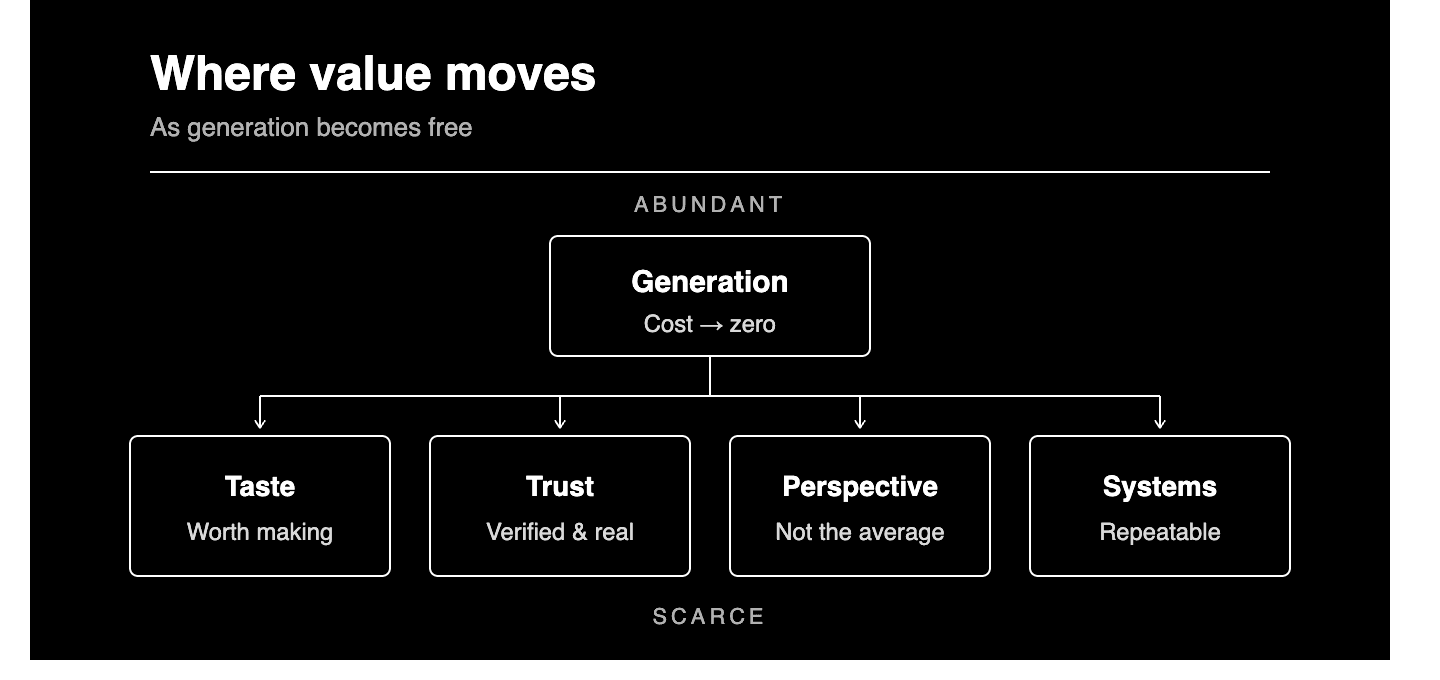
A genuine point of view. AI-generated content, at scale, regresses toward the statistical average of its training data, which is precisely why so much of it reads the same. Content built around an actual, arguable thesis — something a synthesis engine wouldn't produce unprompted, because it isn't the safe average — is structurally harder to commoditize. There's nothing to imitate that doesn't also copy the argument.
Systems, not outputs. This is the one builders miss most often. The valuable asset was never really the video, the track, or the article — it was the repeatable process that reliably produces the right one, verifies it, and gets it to the right audience. A single great synthetic ad is a commodity the day someone copies the prompt. A system that consistently knows which ad to make, why, and for whom is not.
What This Means If You're Building Right Now
The practical mistake, watching founders and creators react to this shift, is competing on the wrong layer. Raw generation — the image, the clip, the track, the line of code — gets cheaper every quarter, regardless of how good anyone's prompts are. Competing there is competing against a falling price, forever.
The layer that's actually defensible is everything above generation: the taste that decides what's worth making, the trust infrastructure that proves it's real when that matters, and the system that turns both into something repeatable instead of a one-off. reKursive Labs is already testing a version of this bet with an internal engine that turns ideas into platform-native content — the wager isn't that generation should be faster, it's that the judgment deciding what's worth generating, and for which platform, is the actual product. It's early and deliberately invite-only, but the logic is the same one this whole piece has been describing: the pipeline is the asset. The clip is not.
AI is not going to kill content. Every domain on the synthesis stack proves the opposite — output is exploding, not disappearing. What it's killing, market by market, is the value of content that can't tell you why it exists, who stands behind it, or why it's better than the version generated a second later by someone else's prompt.
The Choice Ahead
Jean Baudrillard, writing decades before any of this was technically possible, described a world where copies eventually stop pointing back to any original at all — simulations that don't represent reality so much as replace the need for it. In 2026, that's no longer a thought experiment. A film's ending can be quietly rewritten after release. A talent agency can consider representing someone who was never born. A self-driving car can be trained inside a world that was never built.
Reality hasn't disappeared. It's become optional — one input among several, competing for budget against versions that are faster, cheaper, and increasingly harder to distinguish. What decides which one gets chosen, in film, in music, in code, in a company's org chart, is no longer whether something can be synthesized. Almost everything can be, now. It's whether anyone has a reason to trust it, a reason to want it, and a system built to make more of exactly that — on purpose, not by accident.