The AI Native Company - Why Coordination, Not Headcount, Is the Real Constraint
A working model for deciding what to keep in-house, what to hand to agents, and what to staff with humans — based on coordination economics, not on how many tasks "AI can technically do.
Category:
Web Design
Author:
reKursive Content Engine
Read:
10 min
Date:

Every founder building with AI right now is quietly asking the same question: what does a company look like when intelligence is cheap and abundant?
The popular answer is a headcount story. Five people, a stack of agents, and a revenue number that used to require five hundred. It's a seductive story because it's partly true — Lovable reportedly reached $400 million in annual recurring revenue with 146 employees, and [Anysphere's Cursor](https://aibusiness.vc/startups/ai-revenue-leaderboard) is generating roughly $6.7 million in revenue per employee off a $2 billion run rate. Those are real numbers from real companies.
But the headcount story is downstream of a different mechanism, and founders who chase the headcount without understanding the mechanism end up building something fragile. The mechanism is coordination cost. Cheap intelligence doesn't shrink a company by replacing employees with agents one-for-one. It shrinks a company by changing how expensive it is to coordinate work — and it only shrinks the company where that cost genuinely collapses. Where it doesn't, agents get bolted onto the same org chart, the same bottlenecks, and the same headcount, just with a chatbot in the loop.
This article is about telling the difference — and about what's actually left for humans to do once you've drawn the line correctly.
Traditional, AI-Enabled, AI-Native: The Difference Is Structural, Not Cosmetic
Most "is this company AI-native" debates get stuck on vibes. A cleaner test has converged across builders and investors in 2026: remove the AI. If the product or workflow stops functioning entirely, it's AI-native. If it just loses a nice feature, it's AI-enabled.
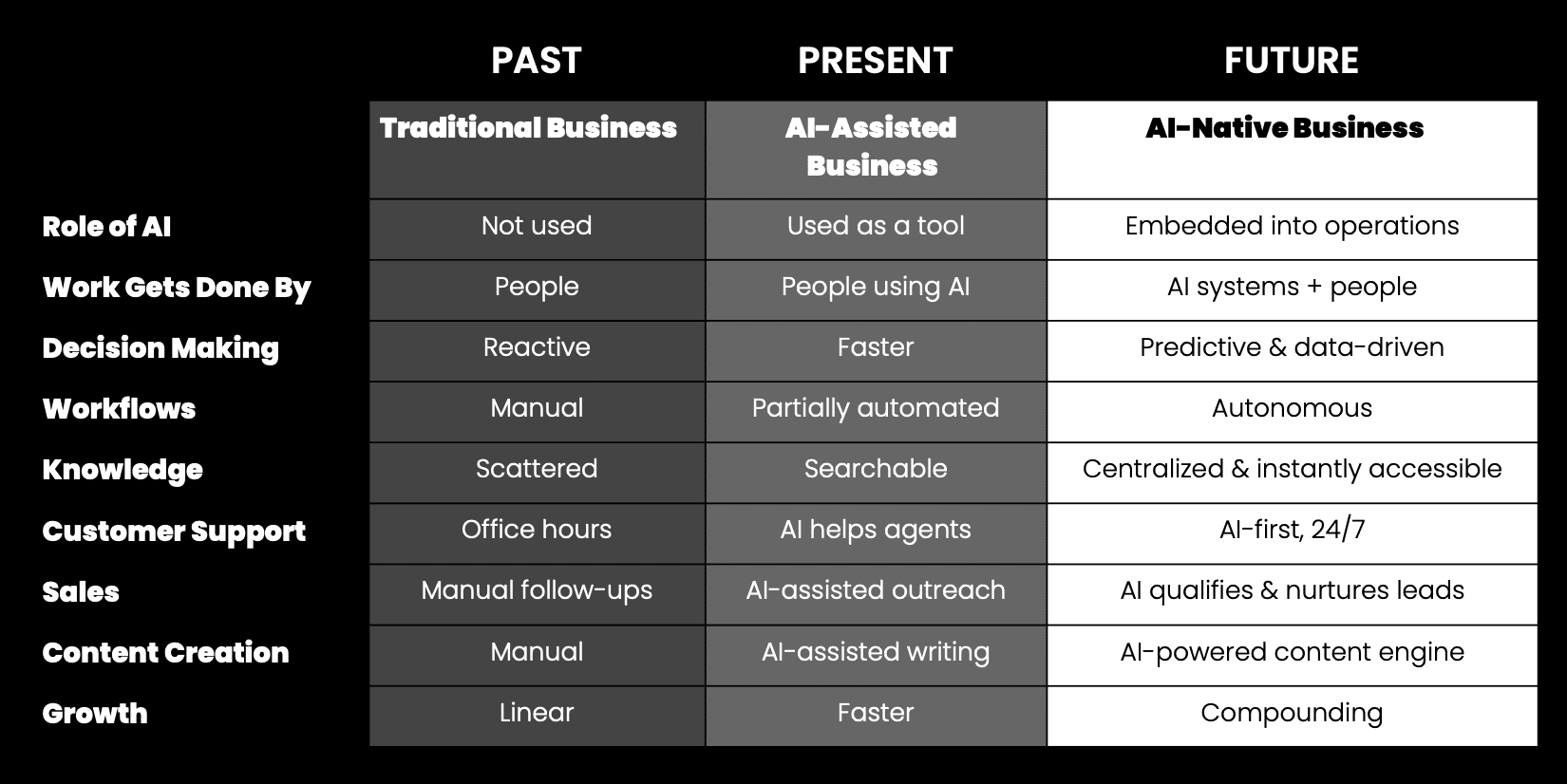
The important cell in that table isn't "AI-native." It's the row for primary constraint. A traditional company is limited by how many people it can hire and manage. An AI-native company is limited by something else entirely: how much it costs to verify that an agent did the right thing, and who's liable when it didn't.
What the Revenue-Per-Employee Numbers Actually Show
The efficiency numbers are genuinely striking. Public SaaS companies now post a median of roughly [$395,000 in revenue per employee](https://www.saasmag.com/revenue-per-employee-saas-org-design-2026/), up from about $327,000 in 2022. The frontier is an order of magnitude beyond that: Lovable's reported $2.7 million per employee, Cursor's ~$6.7 million.
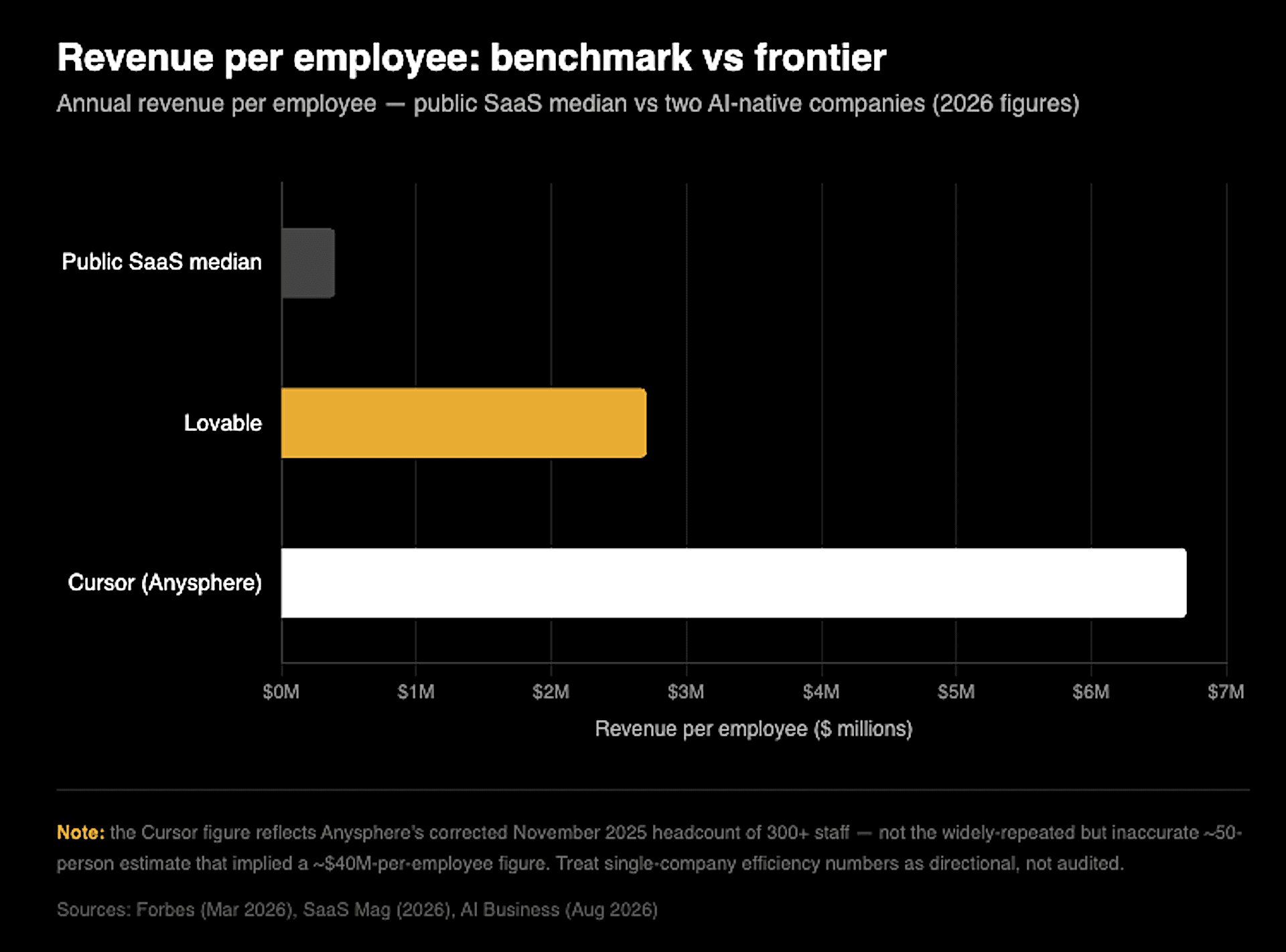
It's worth pausing on that Cursor figure, because the correction behind it is instructive. For months, the widely repeated number was "$2 billion run rate, roughly 50 people, ~$40 million per employee." That number was wrong — Anysphere actually [reported a team of over 300 by November 2025](https://aibusiness.vc/startups/ai-revenue-leaderboard), which puts the real figure closer to $6.7 million. Both numbers describe genuine efficiency. Only one describes reality. The lesson generalizes: most of the "5-person, $50M company" claims circulating in AI Twitter threads are directional at best, and founders who benchmark themselves against unverified numbers are benchmarking against fiction.
None of that changes the underlying pattern, though. Something is structurally different about how these companies generate revenue relative to headcount, and it isn't just "they use ChatGPT." WhatsApp is the pre-agentic ancestor of this pattern: 55 employees serving over 450 million monthly active users at its $19 billion acquisition in 2014. Agentic architectures extend the same logic — a small team plus protocol-mediated coordination can now do work that used to require internal departments, not just internal engineers.
The question is why. And the honest answer is not "AI replaces workers." It's that AI changes what coordination costs.
Why It Matters Now: Coase, Rediscovered
In 1937, Ronald Coase asked a question that sounds almost naive: if markets are efficient, why do firms exist at all? Why not have every task performed by an independent contractor, negotiated fresh each time?
His answer was transaction costs. Finding the right person, negotiating terms, monitoring whether they did the job, and enforcing the agreement all cost something — and when those costs are lower inside a firm's walls than out in the open market, firms grow to absorb the work. A company, in Coase's framing, is a bet that internal coordination beats market coordination for a given set of tasks.
Agentic AI is arguably the biggest shock to that calculus since Coase wrote the paper. A [2026 working paper from Mantix researchers](https://arxiv.org/pdf/2602.21401) formalizes this directly, and the mechanism it identifies is precise: the shift isn't that AI makes coordination cheap, it's that AI changes how coordination cost scales. In old-style software integration (think microservices, or a company built from disconnected departments and vendors), coordination cost grows roughly with the number of connections between components — every new integration adds a new negotiation, a new point of failure, a cost that compounds combinatorially as the system grows. In a protocol-mediated agentic system, where tools and agents talk through a shared, standardized interface (Anthropic's Model Context Protocol is the clearest current example), that cost collapses to scale with how many tasks get done, not how many components are talking to each other.
That distinction — coordination cost scaling with connections versus scaling with throughput — is the actual reason a five-person team can plausibly compete with a five-thousand-person incumbent in some domains and not others. It has nothing to do with how smart the model is. It has to do with whether your workflows can be verified through reusable, automated checks or whether every task requires bespoke, human judgment to confirm it was done right.
The researchers call the resulting shape a "headless firm": a thin layer of human or AI-generated interface at the top that captures intent, a standardized protocol layer in the middle that routes and verifies work, and a wide, competitive market of narrow specialist agents at the bottom doing the execution. Differentiation concentrates at the edges — in how well you understand what the client actually wants, and in how deep your execution specialization goes — while the middle, the coordination itself, becomes a commodity.
This is the actual "AI-native company." Not a smaller version of a traditional company. A different topology.
What the Evidence Shows: Reliability Is the Bottleneck, Not Capability
Here's what the tiny-team narrative consistently underweights: agent reliability doesn't improve linearly, and it compounds badly across multi-step work.
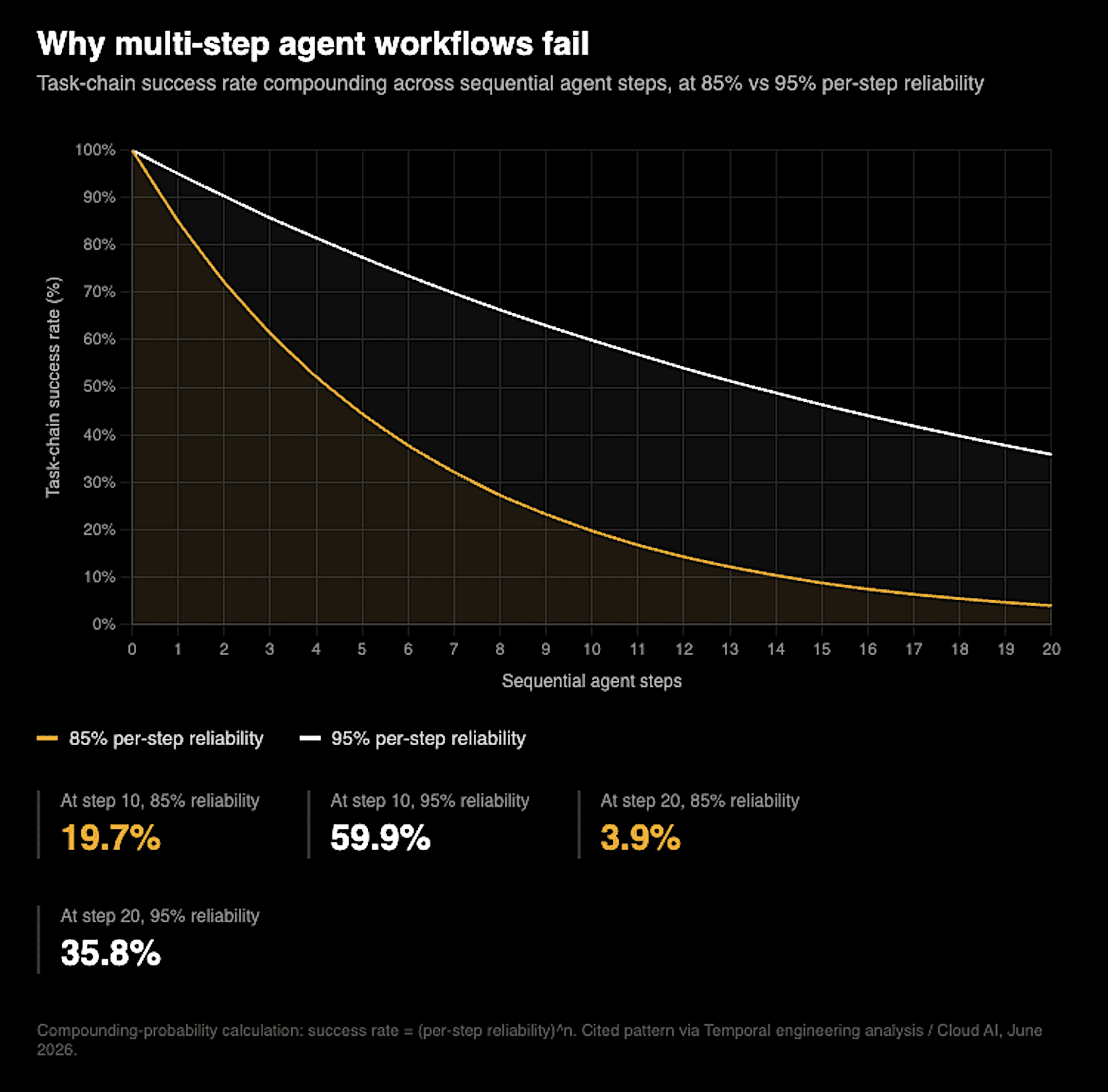
If a single agent step is 85% reliable — a rate most engineering teams would consider good — a ten-step workflow completes successfully only about 20% of the time. At twenty steps, that drops to roughly 4%. This isn't a hypothetical; it's the exact compounding math behind why production agent systems fail at rates that consistently surprise the teams that built them, and it holds regardless of how capable the underlying model is, because the problem is multiplicative, not additive.
The pattern shows up empirically, not just mathematically. A 2025 research taxonomy that analyzed 136 papers on multi-agent system failures — the MAST framework — found production multi-agent systems failing between 41% and 86% of the time, sorted into four structural categories: planning failures, execution failures, coordination failures, and communication failures, spanning 23 distinct sub-patterns. Roughly 42% of observed failures trace back to bad task specification before agents even start working — vague roles, poorly decomposed tasks, no defined stopping condition. Another quarter come from systems that don't verify their own output before passing it downstream.
This isn't a story about immature tooling that will simply resolve with the next model release, either. The 2026 International AI Safety Report specifically calls out that when multiple agents share the same base model or tools, they can exhibit correlated failures — the same blind spot showing up simultaneously across a whole workflow, not just one weak link. And RAND Corporation's analysis of over 2,400 enterprise AI initiatives found that roughly 80% failed to deliver their intended business value — a number that should sober up anyone treating "just add agents" as an organizational strategy.
None of this means agentic automation doesn't work. It means it works within a specific envelope: bounded task width, reusable verification, and — critically — someone accountable for what happens when the compounding math catches up with you.
What People Are Missing: The Liability Floor
The most common strategic error in "AI-native company" planning is treating cost as if it only has one term: compute. Cheaper tokens, the reasoning goes, means cheaper everything, forever, on a Moore's Law-style curve.
That's wrong, and the reason is worth internalizing precisely. The real marginal cost of having an autonomous agent execute a task is compute cost plus the probability of a wrong outcome, multiplied by how much that wrong outcome costs you. For low-stakes drafting work, that second term is negligible — a bad first draft of a blog post costs you a review cycle. For high-stakes actions — signing a contract, executing a financial transaction, filing something with a regulator — the liability term doesn't shrink as compute gets cheaper. It scales with the value of the transaction, not with the price of the model. Insurance premiums don't halve every eighteen months. Liability doesn't either.
This creates what's functionally a permanent floor under "cheap intelligence." It also explains a pattern founders keep getting surprised by: the tasks that are cheapest to automate (drafting, summarizing, first-pass research) are rarely the tasks that were actually expensive for a human team to do. The expensive tasks were expensive because they carried consequence, and consequence is exactly what doesn't get cheaper.
What Actually Stays Human
Strip away the parts of "knowledge work" that are pattern completion, and what's left is smaller than most org charts suggest, but it's not nothing, and it's not vague either. Three categories hold up under the coordination-cost lens:
Judgment that carries liability. Someone has to be the party whose name is on the outcome when an agent's action goes wrong — not because agents can't act, but because accountability, in current law and current trust norms, attaches to a person or a legally liable entity, not to a model weight. The Headless Firm researchers describe a category of firm that survives this transition not by out-executing agents, but by selling exactly this: liability, not labor. They call it, somewhat bluntly, a "trust boutique" — a firm that's shrunk its headcount to almost nothing but keeps existing because someone has to be the accountable human when it matters.
Taste and interpretation of intent. Verification against a spec is automatable. Deciding what the spec should be — reading a client's half-formed brief and knowing what they actually need, not what they literally typed — remains a genuinely human bottleneck, and it's the layer the hourglass model puts at the top for a reason: it's the part that resists standardization because every client's context is different.
Cross-provider coupling. When a decision genuinely depends on holding multiple systems' state consistent at once — not just completing independent tasks in parallel — verification cost stops scaling nicely and starts scaling the way old-style software integration always did: combinatorially. That's a structural signal, not a vibe, for when a task should stay inside a tightly managed human or hybrid process rather than being farmed out to a market of swappable agents.
Notice what's not on this list: creativity in the abstract, strategy in the abstract, "relationship-building" as a vague catch-all. Those get used as a comforting answer to "what will humans still do" far too often, and they don't survive scrutiny once you ask which parts of them are actually pattern completion (most of a first-draft strategy memo is) versus which parts carry irreducible judgment and liability (the decision to bet the company on that strategy is.
Organizational Design: The Hourglass, and Its Infrastructure
If you accept the coordination-cost framing, an AI-native org chart looks less like a smaller pyramid and more like an hourglass:
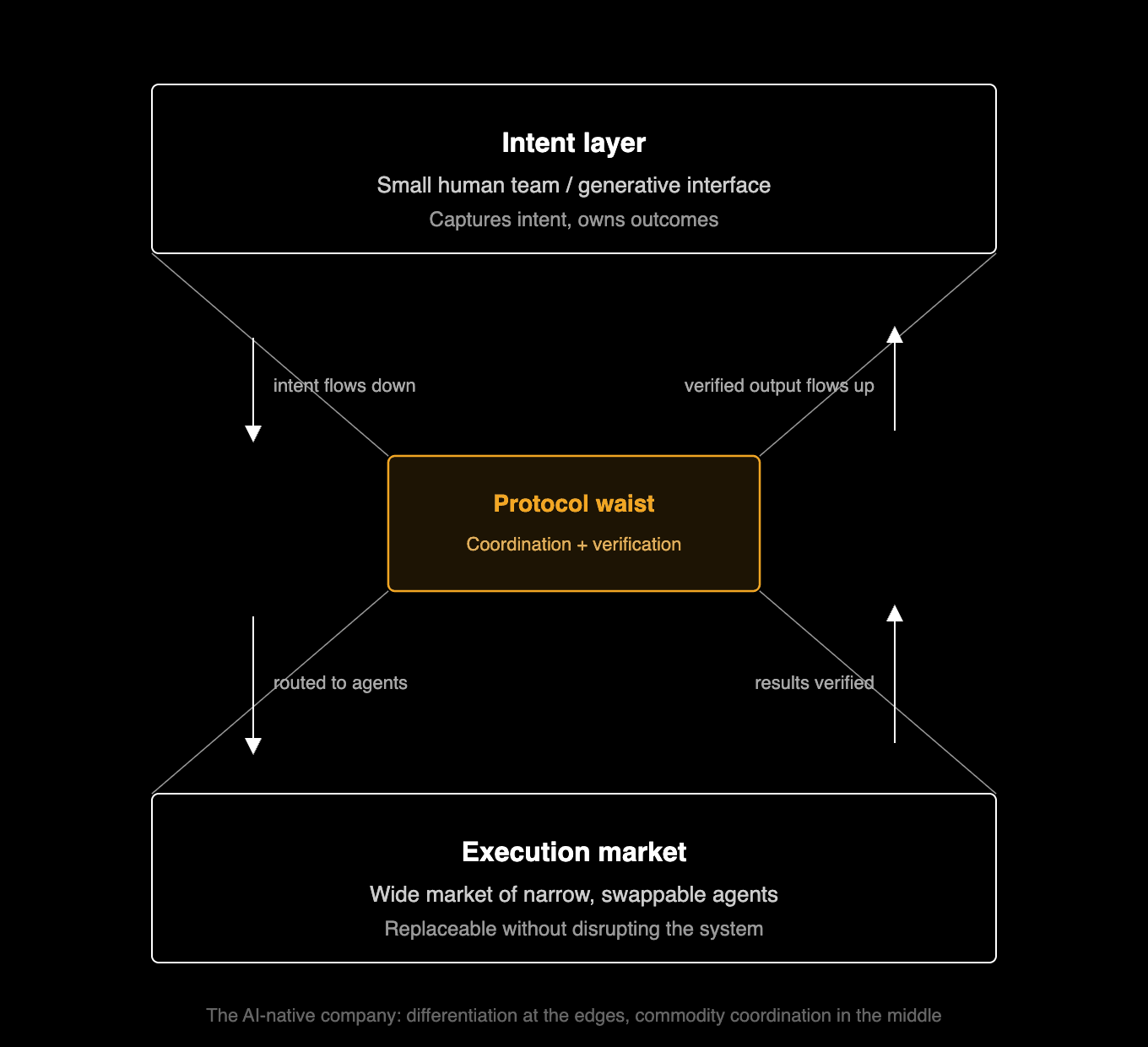
- Top — intent layer. A small number of humans (or a generative interface) who capture what actually needs to happen, translate ambiguous requests into something executable, and own outcomes.
- Middle — protocol and verification layer. Thin, standardized, and increasingly commoditized. This is where reusable evaluation harnesses, policy checks, and audit trails live, and it's the layer that determines whether your coordination cost scales with tasks (good) or with the number of systems talking to each other (bad).
- Bottom — execution layer. A wide, swappable market of narrow specialist agents, each doing one thing within a tightly scoped domain, replaceable without disrupting the rest of the system.
This isn't theoretical scaffolding — an entire infrastructure layer has emerged specifically to make the middle layer real. Agent observability and evaluation platforms (LangSmith, Braintrust, Arize, AgentOps, and others) exist because the "verification" term in the coordination cost equation has to be operationalized somewhere, and in 2026 that's become its own tooling category rather than an afterthought bolted onto general software monitoring. Orchestration frameworks split similarly between SDK-level tools (LangGraph, CrewAI, the OpenAI Agents SDK) that give engineering teams full control, and enterprise platforms that trade control for faster deployment. The existence of this whole stack is itself evidence for the thesis: companies aren't just buying "more AI," they're building out the specific coordination-cost-reduction infrastructure the theory predicts they'd need.
The practical implication for founders: don't ask "which tasks can an agent do." Ask "which tasks can be verified cheaply and repeatably, and which ones require a human because verification itself is the expensive part." The first category is where you get the 5-person-team economics. The second category is where you still need to hire.
The Limits of the Model
The hourglass isn't universal, and the researchers behind the coordination-cost framework are explicit about where it breaks — which is exactly the part most "AI will replace companies" commentary skips.
System-of-record lock-in. Core ledgers, regulated financial state, anything with strict audit and reconciliation requirements resists unbundling regardless of how good the agents get, because the cost of switching or fragmenting the system of record is enormous and largely independent of AI capability.
Regulatory and capital intensity. Finance, healthcare, and manufacturing carry compliance and capital requirements that impose a minimum viable firm size no amount of coordination-cost collapse will dissolve.
Rising coupling intensity. The moment tasks stop being independent and start requiring multiple agents to maintain consistent state with each other — not just each complete their own piece — verification cost stops scaling with throughput and starts scaling combinatorially again, same as the old microservices problem it was supposed to solve. When that happens, the theoretical advantage of the lean, agent-mediated firm evaporates, and re-centralization follows.
Platform concentration. The protocol layer that's supposed to stay thin and neutral has an obvious incentive to thicken into a rent-extracting gatekeeper instead — a dynamic familiar from every prior wave of platform economics. If that happens, the "coordination is now cheap" promise collapses back into "coordination is now cheap, minus a toll."
Put plainly: the AI-native company is the right model for high-knowledge-velocity, low-regulatory-friction, loosely-coupled work. It is very much the wrong model for anything where being wrong is expensive in a way that compounds, or where the systems involved must never drift out of sync with each other.
What This Actually Means for Founders
Stop asking what a company looks like when intelligence is cheap. Start asking, task by task: is this work verifiable through a reusable, automatable check — or does verification itself require the same judgment the task did in the first place?
Where the answer is "verifiable," build the hourglass: thin coordination layer, narrow specialist agents, minimal headcount, and treat every new agent integration as a test of whether your coordination cost is actually staying flat as you add capability, or whether it's quietly creeping back toward the old combinatorial curve.
Where the answer is "verification requires judgment," that's not a temporary gap waiting for a better model. It's a structural signal that the task belongs to a human, and it will keep belonging to a human for as long as accountability attaches to people rather than to weights.
The founders who get this right in the next few years won't be the ones with the fewest employees. They'll be the ones who correctly sorted their company into these two categories before their competitors did — and who built the verification infrastructure to make the first category actually reliable, instead of quietly hoping the compounding math wouldn't catch up with them.
*If you're trying to figure out which parts of your operation actually belong on the agent side of that line — and which ones don't — that diagnostic is the starting point for most of the [AI agent and workflow automation work](/) we do at reKursive. It's rarely obvious from the task list alone.*