The World of Infinite Intelligence: What Happens When Intelligence Stops Being Scarce
A framework for locating defensibility once "we use AI" and even "our AI is good" stop meaning anything, plus a working checklist for auditing where a business's advantage actually lives.
Category:
Portfolio
Author:
reKursive Content Engine
Read:
6 Mins
Date:

For most of business history, intelligence was the scarcest input in the system. You could rent capital. You could lease a factory. You could not rent judgment, and you could barely hire it — good thinking was slow to train, expensive to retain, and impossible to scale past the number of skilled people you could get in a room.
That constraint is dissolving in real time, and most strategy is still built as if it hasn't.
The industry has a name for the first piece of this: LLMflation. In 2024, a16z's Guido Appenzeller tracked the price of running LLMs of equivalent capability and found it falling by roughly 10x every year — what cost $60 per million tokens in 2021 cost about six cents by late 2024. That curve hasn't flattened. Multiple independent 2026 trackers put GPT-4-class inference, which cost around $30 per million input tokens at launch in March 2023, at well under a dollar today — a decline on the order of 95%+ in two years and close to 1,000x over three.
Cost is only one axis. Look at the other five and a pattern emerges:
Cheap — the price of a fixed level of capability keeps falling roughly an order of magnitude a year.
Scalable — the same system that answers one customer answers one million, at marginal cost approaching zero.
Always available — no shift schedules, no attrition, no onboarding time.
Multimodal — one system now reads, sees, hears, and generates across text, image, audio, and video without separate specialist tools.
Personalized — the same interaction can be uniquely shaped to the person in front of it, at population scale, not just segment scale.
Autonomous — increasingly, the system doesn't wait to be asked. It plans, acts, and completes multi-step work with a shrinking amount of human supervision.
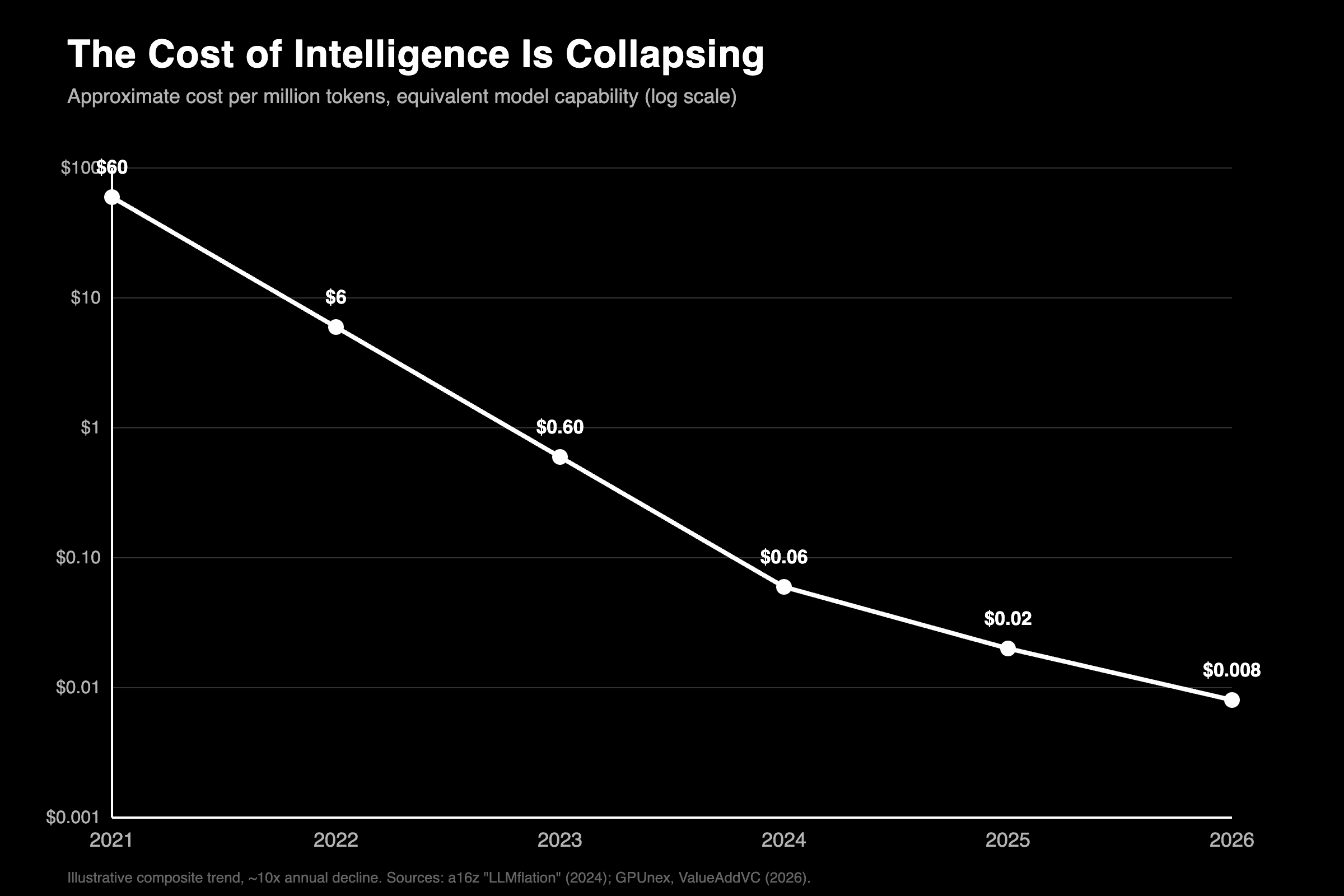
Individually, each of these is a product feature. Together, they describe something bigger: intelligence is completing the same transition electricity made a century ago — from a scarce, specialized capability into ambient infrastructure. Nobody builds a "electricity strategy" anymore. Electricity is assumed. The interesting question stopped being "do we have power" and became "what do we build now that power is everywhere."
Intelligence is about to become just as boring, and just as universal. That's the actual story. The question worth sitting with isn't whether this happens — the cost curve makes that close to inevitable — it's what happens to a business once the thing it used to sell, or the thing it used to need scarce experts for, stops being scarce at all.
The paradox: cheaper intelligence, bigger AI bills
Here's the part most "AI will be free" takes miss. Falling per-unit cost has not led to falling total spend — it's led to the opposite. Enterprise AI budgets have grown roughly six-fold over the same period per-unit costs collapsed, according to 2026 FinOps-sourced tracking, because cheaper tokens make more use cases economically viable, and more viable use cases means more usage: more agents, more retries, more tool calls, more always-on assistants sitting in the background of every workflow.
This is not a contradiction. It's the same thing that happened with compute, bandwidth, and storage. Jevons' paradox — the 19th-century observation that making a resource more efficient to use tends to increase total consumption of it, not decrease it — applies directly. Cheaper intelligence doesn't shrink the AI line item. It expands the surface area of what gets automated, and that surface area grows faster than the price per unit falls.
For a builder, the practical implication is this: don't plan around "AI will get cheap enough that this becomes trivial to run." Plan around "AI will get cheap enough that everyone runs it, and the constraint moves somewhere else." The constraint doesn't disappear — it relocates.
Where the constraint moves
If intelligence itself stops being the bottleneck, four things become the new bottlenecks, and they're worth naming precisely, because they're where the actual business decisions live now.
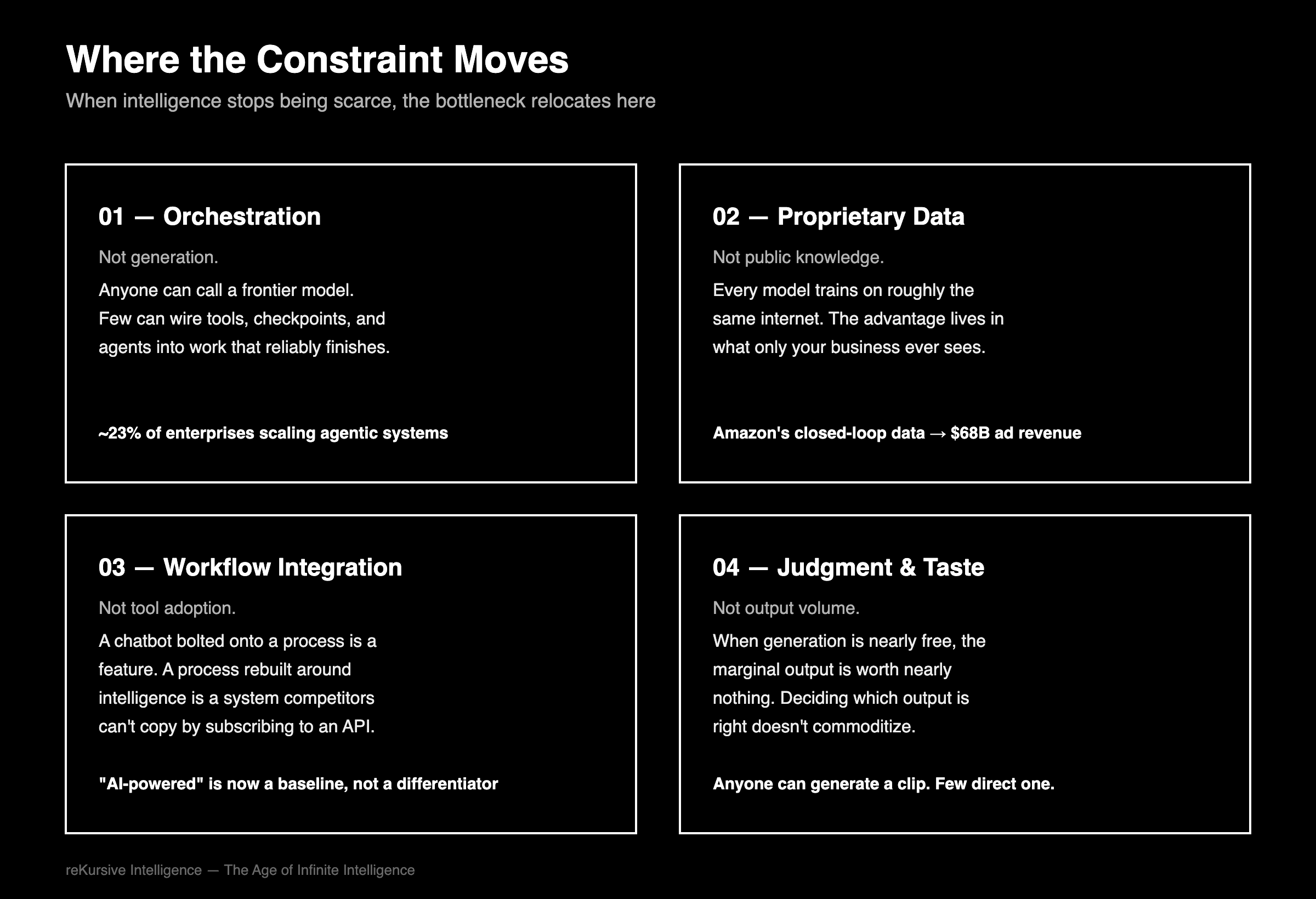
1. Orchestration, not generation. Any team can call a frontier model. Fewer teams can wire fifteen model calls, three tools, a retrieval layer, and a human checkpoint into something that reliably finishes a real job without falling over. Gartner's tracking shows the gap clearly: agentic AI headline adoption sits near 79–88% of enterprises reporting some use, but the share actually scaling a production agentic system is closer to a quarter. The distance between those two numbers is the orchestration gap, and it's currently the single most valuable skill gap in the market.
2. Proprietary data, not public knowledge. Every frontier lab trains on roughly the same public internet. The advantage was never going to live there. McKinsey's research on AI moats points to Amazon as the clean example: the company's behavioral, transactional, and fulfillment data — accumulated inside a closed loop no competitor can see — feeds an advertising business that reached an estimated $68 billion in revenue in 2025. That's not an AI capability advantage. It's a data advantage that AI happens to make more valuable than it used to be. McKinsey's broader research on "AI-rewired" companies found EBITDA improvements in the 10–30% range, averaging around 20% — but the lift came from organizations restructuring around proprietary data and workflows, not from access to a smarter model.
3. Workflow integration, not tool adoption. A chatbot bolted onto an existing process is a feature. A process rebuilt so intelligence sits inside every step — sensing, deciding, executing, and improving on a feedback loop — is a system competitors can't just copy by subscribing to the same API. Multiple 2026 strategy analyses converge on this point independently: once "AI-powered" stops being a differentiator and becomes a baseline expectation, defensibility shifts to how deeply intelligence is embedded in a specific, owned workflow rather than whether it's present at all.
4. Judgment and taste, not output volume. When generation is nearly free, the marginal unit of content, code, or analysis is worth nearly nothing. What doesn't get commoditized is the decision about which output is right, which one earns trust, and which one reflects an actual point of view. This is where "AI cinema" as a discipline is instructive: anyone can generate a video clip now. Almost nobody can generate one with a director's judgment behind every frame. The clip is cheap. The judgment isn't, and won't be for a long time.
The multimodal and personalization shift changes what "product" even means
The older design constraint in marketing and product was a straightforward trade-off: build something highly personalized, or build something that scales to a large audience — rarely both. Multimodal systems, which fuse text, image, audio, and video into one adaptive layer, are collapsing that trade-off. A system that can read a customer's message, notice tone in a voice note, and adjust a generated visual in the same interaction doesn't have to choose between depth and reach. It can do both, for every user, simultaneously.
This is a bigger shift than "better marketing personalization." It changes the unit economics of service businesses generally. A consulting relationship, a creative direction session, or a 1:1 coaching relationship used to be personalized because a human was doing it, and expensive because a human's time doesn't scale. Multimodal, autonomous systems threaten that bundle directly: personalization without the scaling penalty. Businesses whose entire value proposition was "we give you individual attention at a price only individual attention could justify" need to ask, honestly, how much of that attention was actually judgment versus how much was pattern-matching that a sufficiently well-orchestrated system can now do continuously, for everyone, at once.
What happens to businesses when intelligence is no longer scarce
Return to the founding question. If intelligence stops being scarce, three things happen to businesses that built their advantage on having it.
First, the floor rises and the ceiling gets crowded. Baseline competence — a competent support agent, a passable first draft, a reasonable first-pass analysis — becomes available to every competitor at close to zero marginal cost. That's good for customers and brutal for anyone whose whole pitch was "we're competent." Competence stops being a differentiator the moment it's ambient.
Second, advantage concentrates upstream and downstream of the model, never inside it. Upstream: who owns the proprietary data and the customer relationship that generates it. Downstream: who has the taste, judgment, and accountability to decide what the system should actually do and stand behind the result. The model in the middle is rented infrastructure, same as compute or bandwidth. Marc Andreessen's framing from a16z's January 2026 LP discussion captures this bluntly: the moat was never going to be the model — pricing power concentrates in workflow lock-in and proprietary data loops, not in whoever has the smartest weights this quarter.
Third, speed of learning becomes the closest thing left to a durable advantage. If two companies have access to the same intelligence, the one that iterates its workflow, retrains its own routing decisions, and compounds its proprietary data faster wins — not because it's smarter, but because it's faster at getting smarter. McKinsey's language for this is "organizational velocity" as a strategic metric, not just an operational one: measuring clock speed from idea to proven value to scaled deployment, and removing whatever slows that cycle down.
None of this means intelligence becomes worthless to a business. It means intelligence stops being a source of advantage by itself, the same way having electricity in your factory stopped being a competitive advantage once every factory had it. What you do with cheap, always-on, multimodal, autonomous intelligence — which workflows you rebuild around it, which data you feed it that nobody else has, which judgment calls you refuse to hand it — that's the entire strategic question now. The intelligence part got solved. The "what for" part didn't.
A practical audit: where does your advantage actually live?
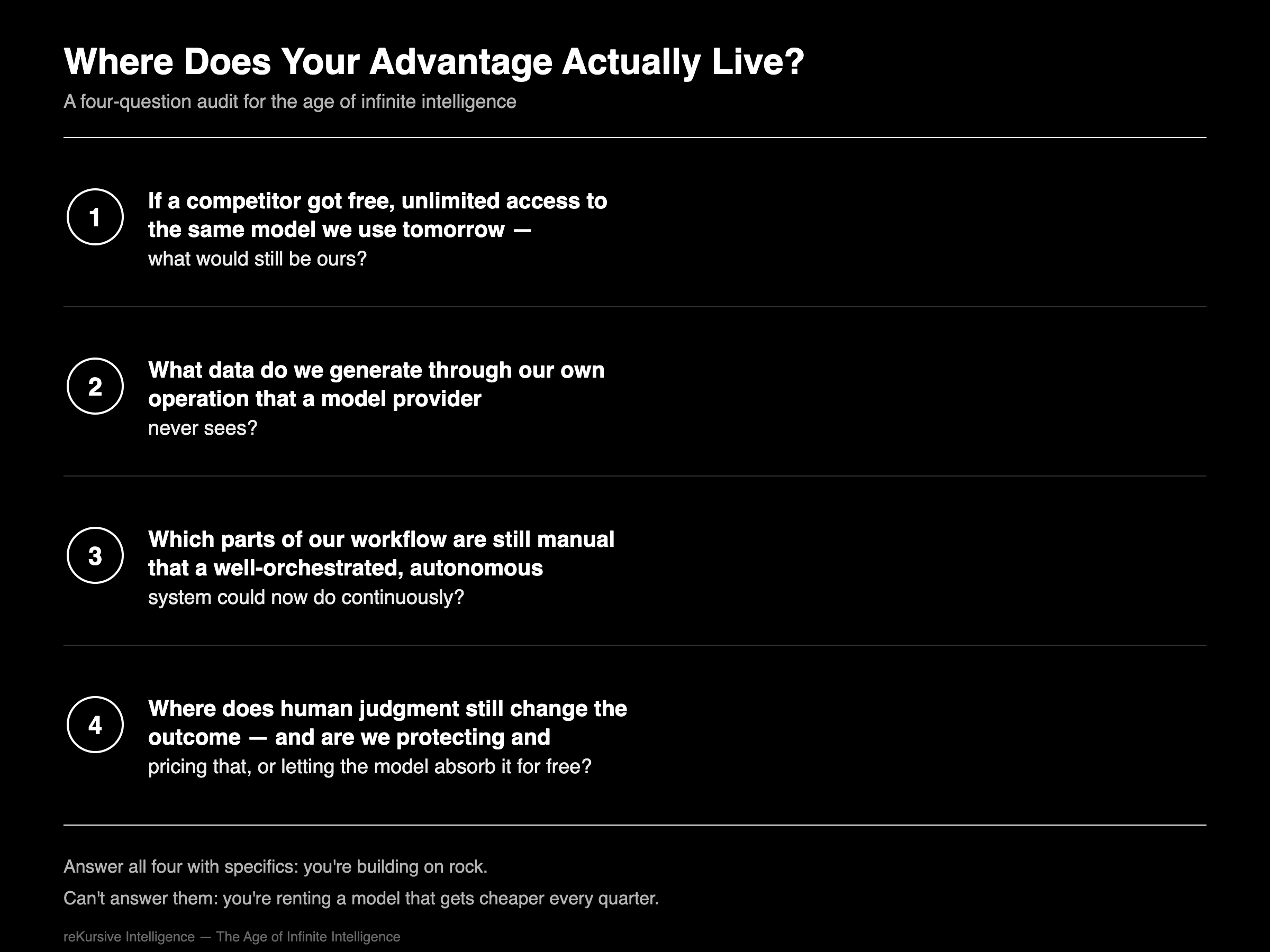
For a founder or operator deciding what to build in this environment, four questions do most of the work:
If a competitor got free, unlimited access to the same model we use tomorrow, what would still be ours? If the honest answer is "nothing," the business is renting a temporary information asymmetry, not building an asset.
What data do we generate through our own operation that a model provider never sees? That data — not the model — is the compounding asset.
Which parts of our workflow are we still doing manually that a well-orchestrated, multimodal, autonomous system could now do continuously? That gap is either an efficiency opportunity or a warning sign, depending on whether it's your workflow or a competitor's.
Where does a human judgment call still change the outcome, and are we protecting and pricing that judgment, or quietly letting the model absorb it for free?
Businesses that can answer all four with specifics are building on rock. Businesses that can't are building on a rented model that gets cheaper, and more replicable, every single quarter.
Intelligence stopped being the scarce resource. Orchestration, data, judgment, and speed are what's scarce now — and reKursive builds the agentic systems and AI workflows that let a business own that layer instead of renting it.